Showing posts with label VEGAN WINE. Show all posts

Thursday, November 20, 2014

Have A Vegan Wine And Cheese Party!Stock Up On Miyoko's Artisan Vegan "Cheese" Perfect For Holiday Entertaining

Finally, Vegan "cheese" that tastes like cheese. Thanks Miyoko!

Follow Foods For Long Life on Facebook and Pinterest.
Need holiday ideas? Download Health Begins in the Kitchen
on Amazon and iTunes.

Really, it Tastes Like Cheese!
I've always been very honest with you about vegan "cheese" because, let's face it, most of it is horrible. Some fake "cheese" products are passible buried in a lasagna or enchilada casserole but they simply do not taste good on a cracker and I certainly wouldn't ruin a good glass of wine eating them.

But Miyoko's Kitchen has produced a wide variety of "Cultured Nut Products" (they legally can't call it cheese because it lacks dairy) that are out of this world. 

A few years back, Miyoko tried to inspire people to make their own in her book, Artisan Vegan Cheese but enough people encouraged her to just make the "cheese" products and sell them. Well, she finally did just that and many vegans and those allergic to dairy, like myself, are very grateful. And, they are all gluten free.


If you want to try and do this yourself, buy
Artisan Vegan Cheese by Miyoko Schinner

Lots of Products to Choose From
I haven't yet tried them all but I'll list them for you.

Classic Double Cream Chive
This one is amazing. I grated some on a baked potato with a spoonful of Tofutti sour cream and I was in heaven. You can also use some to stir into your vegan mashed potatoes for Thanksgiving dinner. You won't be disappointed. 
This has a 60 day shelf life.
Double Cream Chive pairs well with a tannic Chianti, Pinot Gris or Sauvignon Blanc.


Double cream chive on top of a baked potato with Tofutti

Double Cream Sundried Tomato Garlic
I also loved this one and crumbled it on top of a homemade veggie pizza. It didn't really melt  but the flavors were wonderful. I think next time I will spread it on the crust first before putting the veggies on or grate it so it's thinner. It think it would melt if it were stirred into hot pasta. It would go beautifully with a nice Chianti.
This product has a 60 day shelf life.


Double Cream Sundried Tomato Garlic on veggie pizza

High Sierra Rustic Alpine
I think this one is my favorite. It's semi hard so it cuts well if you want to put it on a cracker or a slice of apple. To me it has the flavor of an aged cheddar with hints of bacon. I wanted to try making a panini with this "cheese" but I loved it so much I just consumed it all before I had a chance. Time to buy more!
Although I can't imagine it lasting very long in the fridge, this product has a nice long 90 day shelf life.
High Sierra Rustic Alpine can stand up to a good Cabernet Sauvignon but is also delightful with a Sauvignon Blanc. 


Fresh Loire Valley in a Fig Leaf
This soft wheel is beautifully wrapped in a wine-cured fig leaf. I haven't had a chance to try this one yet but Miyoko suggests serving with fruit and crackers and pairing with a full-bodied Cabernet Sauvignon, a classic Bordeaux or a Semillon. 
It has a shelf live of 60 days.


I'm borrowing this picture from Miyoko's website so you can
see just how beautifully this one is presented.

I will get a chance to finally try this one on Friday!

French Style Winter Truffle
Marbled with truffle-scented mushrooms, this earthy delight was my daughter's favorite. Perhaps that's because it paired so beautifully with our Turtle Vines vegan Russian River Pinot Noir!
This product has the shortest shelf life of 30 days but do you think it would last that long around your holiday guests? I think not.

Read more about why you should drink vegan wine.

Aged English Sharp and Aged English Smoked Farmhouse
I tried the sharp version which was wonderful just on a simple cracker. It tasted like an aged cheddar with very complex flavors and paired nicely with a Petite Syrah.
Both of these have a nice long shelf life of 90 days.

Country Style Herbes de Provence
This beautiful wheel is encrusted in herbs and since it pairs beautifully with champagne and Prosecco, what better "cheese" to serve on New Year's Eve? But you obviously have to be a fan of Herbes de Provence.
This one also has a nice long shelf life of 90 days.


Country Style Herbes de Provence

How to Buy
Since these are made in Fairfax, California, I assume the product will start popping up in some local grocery stores in Northern California soon. I believe it is being carried in a Whole Foods in Novato and in the Community Market at the Barlow in Sebastopol. But if you can't find it in your town, you can buy it online at Miyoko's Kitchen Website. Right now you can only buy preselected collections of these "cheeses" and are not able to select individual products (I don't know if that will change in the future). For example:

The Harvest Collection contains: 
Fresh Loire Valley in a Fig Leaf
French Style Winter Truffle
High Sierra Rustic Alpine
Classic Double Cream Cheese
Double Cream Sundried Tomato Garlic

The Traditional Collection offers:
Aged English Sharp Farmhouse
Aged English Smoked Farmhouse
High Sierra Rustic Alpine

The Party Platter contains:
A Limited Edition Double Cream Garlic Herb
Fresh Loire Valley in a Fig Leaf
French Style Winter Truffle
High Sierra Rustic Alpine
Aged English Sharp Farmhouse
Double Cream Sundried Tomato Garlic

But if you are going to pay for shipping, you might as well load up on these wonderful products and get a chance to taste a wide variety of them. Miyoko suggests you order before Monday, November 24th at 12:00pm (PST) if you want delivery before Thanksgiving.

A big THANK YOU to Miyoko for making these wonderful products!


Sunday, November 2, 2014

Not All Wine Is Vegan And Gluten FreeFind Out What's In Your WineTry Our 2012 Turtle Vines Pinot Noir

Our Turtle Vines Pinot Noir is raw, vegan, unfined, unfiltered, gluten free and made from certified organic grapes.

Follow Foods For Long Life on Facebook and Pinterest.
Download my eBook, Health Begins in the Kitchen,
on Amazon and iTunes.

What's in your Wine?
Even if you're not a vegan you may not relish the idea that the wine you are drinking was mixed with gelatin from pigs, cows, and fish bladders, egg whites, and other distasteful animal ingredients, during the winemaking process. And for those of you who are lactose or gluten intolerant, you may be concerned that milk protein and wheat gluten may also have been used. 

Why is this done?
Many wineries have a formula for making wine that produces a consistent product from year to year that is less dependent on the quality of the grapes they use. The commercial process that is used to create a clear and stable wine or to fix defects is calling "fining". 

Fining
Fining is the operation of adding one or more compounds to wine to bring it into balance and keep it there. Many of these compounds are from animals, gluten and other surprising materials. Although these compounds are filtered out of the wine before it is bottled and sold, there potentially could be some residue in the wine, albeit very minuscule amounts. Here's are some examples:
* Isinglass (fish bladder) is used to clarify wine.
* Gelatin (pork, cow and fish skin and bones) clarifies wine and removes excess tannins.
* Plant proteins (either green peas or hydrolyzed gluten) is used to clarify wine and remove excess tannins. Pea protein is appropriate for vegan wines.
* Egg albumin is used to clarify wine and remove astringencies in red wine.
* Potassium caseinate (milk protein) improves aromatic defects and treats oxidized wines.
* PVPP (plastic) is used to treat bitterness.
* Bentonite (clay) is used for rapid clarification and to treat protein-unstable wines.Bentonite is appropriate for vegan wines.

Is Fining Necessary?
Our Turtle Vines Pinot Noir is not fined or filtered. No animal products, plastic, or gluten is used in the production of our wine. It is simply not necessary.

To achieve clarity, we "rack" our wine. Racking is the process of letting the wine settle and then siphoning it into another vessel. This is done three times. Occasionally there is a bit of residue at the bottom of our bottles but that doesn't bother us - it's better than adding these odd and distasteful compounds listed above.

To balance our tannins, we "cold soak" our destemmed (and about 5% whole-cluster) grapes for five to ten days before fermentation to bring out the beneficial, water soluble skin tannins. 
We prevent excess tannins by ending fermentation and pressing the wine before the wine goes completely dry. This controls excess tannins from the grapes seeds by limiting how long they soak in the fermented wine.

Tannins can also seem out of balance if the acidity and alcohol levels are inappropriate. Acid levels are controlled by measuring and adding tartaric acid when necessary. Correct alcohol levels are controlled by picking the grapes when their target sugar content (and flavor) is achieved. With the proper acidity and alcohol levels, fining is not necessary to adjust tannins. 

All these methods of carefully balancing tannins prevents having to deal with astringencies and bitterness.


Cold soaking before fermentation 

Controlling aromatic defects is much easier to control when you grow and hand-pick your own grapes. At Turtle Vines we examine every grape cluster continually throughout the growing season, discarding any that have mold or mildew or that are not ripe enough to pick. Many large wineries machine-harvest their grapes allowing more bad grapes to end up in the fermentation tank. 

The Importance of Organic Grapes
When you go grocery shopping for grapes, many of you buy those that are organically grown. Every year table grapes are listed as one of the Environmental Working Groups "Dirty Dozen". Their 2014 audits showed that table grape samples has residue of at least 15 pesticides. But when you buy a bottle of wine, most people don't even think about whether or not the grapes used to make the wine are organic. Conventionally grown wine grapes can be treated with synthetic pesticides, fungicides, insecticides, and fertilizers. 

According to the California Department of Pesticides Regulation, 25 million pounds of pesticides were applied to conventionally-grown wine grapes in California in 2010. These wine grapes had far more pesticides than table grapes. According to the USDA Pesticide Data Program, there are up to 34 different kinds of pesticide residues found on conventionally-grown grapes! 

Our grapes at Turtle Vines Vineyards are certified organic by the California Certified Organic Farmers Association. It is not only important for our wine to be free of these toxins to protect you, but we did not want ourselves, our workers, our neighbors, or wildlife to be exposed or subjected to these harmful chemicals. 

We do not, however, make organic wine. The difference between organic wine and wine made from certified organic grapes is that organic wine does not allow for the addition of sulfur dioxide. Since sulfur dioxide prevents bacterial spoilage, very few wines are made organically as they have a short shelf life. We feel that the majority of benefits to the consumer are obtained by wine being vegan and made from certified organic grapes. 


Is Wine Raw?
During fermentation, temperatures rise but generally stay below 85 degrees so, from that standpoint, wine is considered raw. However, some winemakers add sugar during the winemaking process to achieve their target alcohol content (not to make the wine sweeter). Unless the sugar used was raw sugar, some would consider this wine not to be raw. 

This process of adding sugar to wine is called "chaptalization" and it is generally done in regions that have poor climate and produce grapes with low sugar content. This practice is illegal in Argentina, Australia, Austria, California, Italy, and South Africa. So you can be assured that wines from these regions were not made with sugar. Our California wines have plenty of sunshine and ample sugar content and don't need this added sugar.

Our 2012 Turtle Vines Pinor Noir is Now Available
If you are interested in purchasing our Pinot Noir, please go to our Turtle Vines Website.
Our wine is raw, vegan, unfined, unfiltered, gluten-free, and made with our hand-farmed organic grapes. 

The 2012 Pinot is about 80 percent Pommard and 20 percent 667 with a lower alcohol content of 13.0%. This produces a feminine style wine with a taste of ripened strawberry, currant, and cassis. It is a very versatile and food friendly wine which complements almost any dish from pasta to chocolate truffles!

If you mention Foods For Long Life, you will get additional 10% discount. Stock up for the holidays!


Mention Foods For Long Life and get an additional 10% off
our 2012 Turtle Vines Russian River Pinot Noir


Wednesday, September 25, 2013

How To Make Russian River Pinot Noir

Pinot Noir grapes from our Turtle Vines vineyard in Sebastopol, California.

Check out my eBook, Health Begins in the Kitchen.
Follow Foods For Long Life on Facebook.

We've been really busy with harvest and making wine this month so I thought I'd write a little about this other part of my life, when I'm not creating recipes or writing my blog.

Five Fun Facts about Pinot Noir
1. Pinot Noir is the same as French Burgundy
2. The movie Sideways caused the consumption of Pinot Noir to increase and the consumption of Merlot to drop.
3. Pinot Noir is raw and vegan (if not filtered). Fermentation temperatures never get that hot.
4. Pinot is known as the Heartbreak Grape as it requires a lot of attention in every phase of the winemaking process. Andre Tchelistcheff, a famous winemaker, once said, "God made Cabernet Sauvignon, whereas the Devil made Pinot Noir."
5. Some of the best places to grow Pinot Noir are Burgundy France, Sonoma County in California, Willamette Valley in Oregon, Central Otago in New Zealand, Ahr region in Germany, and Northern Italy. 

From Silicon Valley to Russian River Valley
My husband Doug and I met 24 years ago in Silicon Valley where we both had stressful jobs in the high tech industry. Collectively we had spent over six decades in the world of engineering - sitting in meetings, working in laboratories or factories, or riding airplanes, never feeling the sun on our backs or breathing fresh air. For as long as we've been together, we talked about moving to the country and starting a vineyard. Five and a half years ago that dream came true.

We found the perfect spot in the small town of Sebastopol, about one hour north of San Francisco. The house needed quite a bit of remodeling and there was just a big empty field behind it which would be the future home of over 3,000 organic Pinot Noir vines. I don't think we realized at the time how much work it would take.


2009 - big empty field
2013 - vineyard before harvest with bird netting

Doug took viticulture and wine making classes at the Santa Rosa junior college. Only in Sonoma county would you find a JC with its own 70 acres of vines, professional wine making equipment, and professors with impressive experience in the wine industry. With the help of some really smart people, we took soil samples, designed the vineyard, selected the precise clones of Pinot Noir to plant, and planted 3,130 healthy little vines.

It took 4 years until our first harvest which yielded a little over one half ton of grapes. This year we harvested two and a half tons. Ultimately our little vineyard will yield over five tons, enough to make three hundred cases of wine. This year we sold two tons of grapes to a local winery that appreciates that our grapes are organic. We saved a half ton to make some wine. I thought it might be fun to show you how we do that!

              *                          *                           *

Pinot Noir
Raw Vegan, Gluten Free
[makes 1,800 glasses or 360 bottles]
Requirements: a whole bunch of expensive equipment and lots of patience

Ingredients:
1/2 ton ripe Pinot noir grapes
100 pounds of dry ice, divided
120 ppm metabisulfate, (more or less) divided 
tartaric acid, as needed
300 g Go-Ferm yeast starter
50 g Assmanshausen or other wine yeast
2.5 g ML culture 

Step 1 - Picking the grapes:
Grapes are picked when their sugar content is around 24% (in wine lingo, that's called 24 brix). This is measured by placing grape juice from a carefully selected sample of grapes into a tool called a refractometer.


Refractometer used to measure brix

In addition to having the correct brix measurement, the seeds need to be nice and brown. Of course the final criteria for harvesting is that they taste great. The grapes are then picked early in the morning, while they are still cool, and placed in picking lugs that hold about 40 pounds of grapes.


Doug and a lug of grapes from our 2012 harvest.

Step 2 - Destemming the grapes:
Remove the grapes from their stems. (Some wine makers leave some of the grapes as full clusters). We use a piece of equipment called a destemmer to do this step.

The destemmer sits on top of a fermentation tank. It removes the stems from the grapes and the berries drop into the tank. If some of the stems fall through, make sure to pick them all out.


Doug pouring grapes into the destemmer.
My friends Lauren and John pulling out stems that fell through.

Step 3 - Cold soaking the grapes
To enhance the color and flavor of the wine, cold soak the grapes for five days. Big wineries do this with cooling coils around the tanks. We do it by placing dry ice in the fermentation tanks which makes it look like a witches cauldron! 


Using dry ice to cold soak the grapes.

To try and keep the grapes below 50 degrees F, stir in dry ice chunks every day. To prevent spoilage, add a small amount of metabisulfite (30ppm).

Step 4 - Analysis
While the grapes are cold soaking, send the juice out to a laboratory to determine its acid profile, pH, and final brix (hoping that the brix of the entire harvest matches that of your sample).

Step 5 - Adjust the acid
Pinot should have a TA, or titratable acid, of 0.7 to 0.75 grams per liter prior to fermentation. If it's lower than that, you need to add acid. Our TA was 0.55 so we stirred in some tartaric acid.


Adding tartaric acid.

Step 6 - Fermentation
Now for the good stuff - the conversion of the natural sugar in the grapes into alcohol.
For this you'll need two things:
* A type of yeast used for wine fermentation - we use Assmanshausen Yeast.
* Added nutrients to enhance fermentation - Go-Ferm Yeast Starter Nutrient

First, add the Go-Ferm to one quart of 110 degree F water. When the solution cools to 102 degrees F, add the yeast. Set the bucket of yeast, water, and Go-Ferm, into the  fermentation tank to chill the yeast. Once chilled to within 10 degrees of the grapes, add a little grape must (grapes/juice) into the bucket.


Bucket of yeast, Go-Ferm, and some grape must.

Spread the contents of the bucket over the top of the grape must. Leave as is, covered, for 24 hours in order for the yeast colonies to form.


The light streaks show the yeast solution.

After 24 hours, start punching down the top of the grapes to keep the skins incorporated into the juice. As fermentation continues, the skins will dry out and separate from the juice forming a thick cap over the fermentation tank. This cap must be punched down about twice a day during fermentation.


We use this stainless steel grape stomper to punch down.

Fermentation typically takes from 5 to 10 days. During punch down, measure the juice for its sugar content to see if the yeast are finished converting it to alcohol. A hydrometer is used for this measurement. When it hits zero, the grapes are ready to press.


The hydrometer looks like a long thermometer.
It floats in the juice - when it settles, the % sugar measurement can be read. 

Step 7 - Pressing the grapes
After fermentation, it's time to press. Since we have such a large amount of grapes, we purchased a bladder press. The bladder is in the center of the press and receives water pressure from an ordinary garden hose. When the bladder fills up, it gently squeezes the grapes and the juice pours out of the press. 


Bladder press

Place the pressed juice in a large container that has been sterilized. We used two forty gallon, food-grade containers. Let it sit for 24 to 48 hours.

Step 8 - Rack off the Gross Lees
After one or two days, sediment  will settle out of the wine. The heavy sediment that drops out in first day is called gross lees. Although some wine makers allow the wine to remain on the gross lees for an extended period of time, this could possibly introduce harsh flavors to the wine so many winemakers siphon the wine off of the gross lees into another vessel after one or two days. This is called racking. After racking, the wine is much purer with a small amount of fine lees that, unlike the gross lees, can be beneficial for the wine and becomes a source of nutrients for secondary or malolactic fermentation.

To rack the wine with a siphon, the pressed wine must be higher than the vessel you are racking into. We raised the pressed wine higher with the lift on the back of our pickup truck.

Step 9 - Malolactic Fermentation
Pinot noir grapes naturally contain three types of acid - tartaric, citric, and malic. To soften the harshness of malic acid, winemakers initiate Malolactic Fermentation (MLF), a process that turns malic into lactic acid (a softer acid that makes the wine more rounded and drinkable).

Prepare ML bacterial culture. Add 2.5 g of freeze-dried ML powder to 50 g of room temperature water or prepare according to directions. Add solution to racked wine.


Adding Oak during MLF
Adding oak during MLF allows the flavors to better integrate into the wine. Since we do not use oak barrels, we use little oak balls. Yes, I know, oak barrels are romantic and traditional and most winemakers scoff at the thought of using oak adjuct, but hear me out.

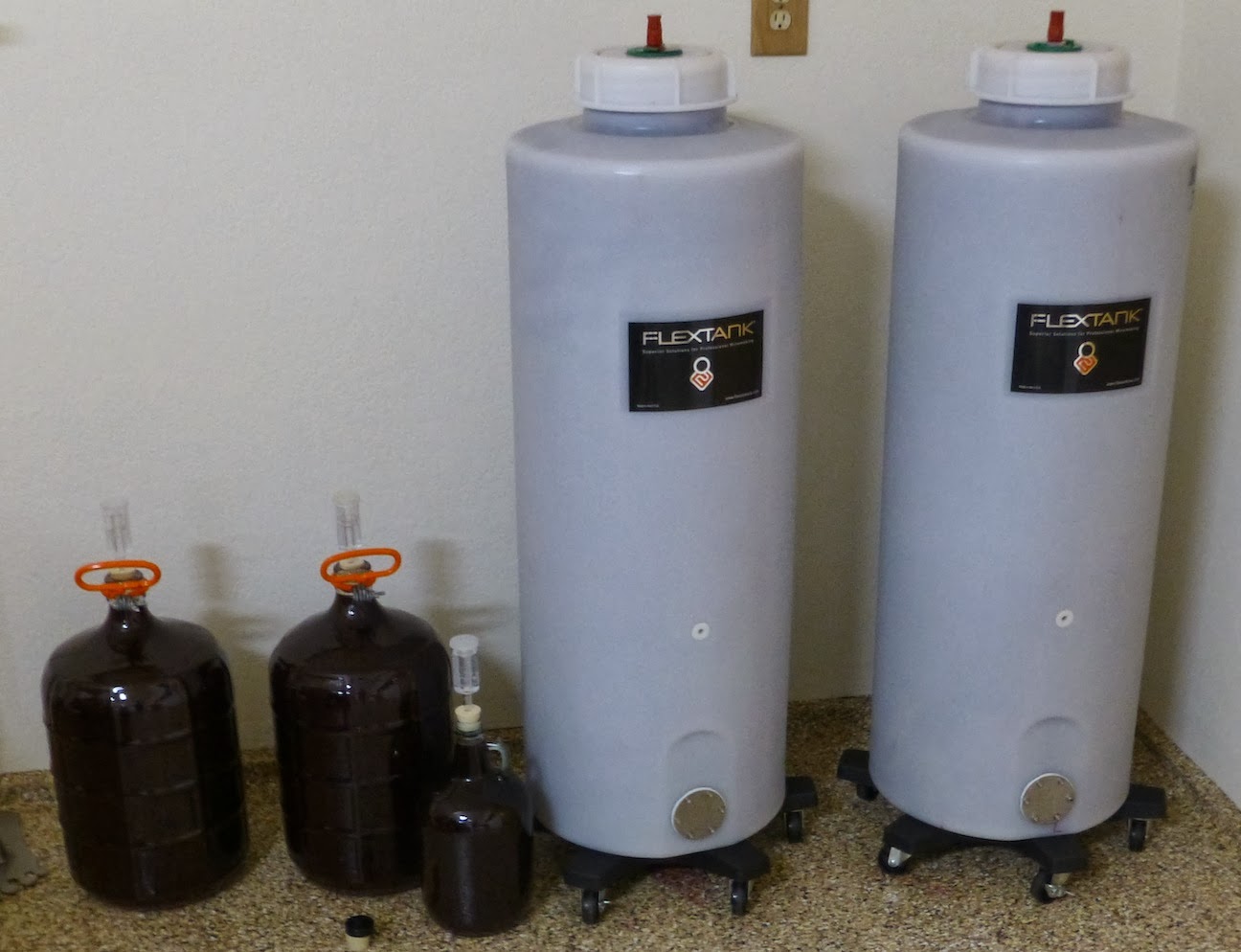
Our environmentally friendly, polyethylene, oxygen permeable Flextank is equivalent to a neutral barrel and doesn't impart any flavors into the wine but it breathes. It also removes the risk of a barrel introducing funky flavors or pathogens. 
By adding oak balls, or Medium Plus Xoakers, we can select the exact oak flavors we desire.  
We did an experiment with 4 types of oak by making extractions (actually martinis). After soaking them for several weeks in vodka, we observed the aromas from each solution and selected the one we liked the most. For us, that was medium plus toasted French oak.


Medium Plus Xoakers
How we selected our oak.

Add oak Xoakers to the vessel containing the racked wine.

Place oak balls into Flextank containing racked wine.

Add the ML bacterial culture to the vessel.

Adding ML solution.

Notice that the vessel is filled fairly high to minimize exposure to oxygen. 
Malolactic fermentation will begin as soon as the bacterial culture is introduced to the wine. 
Stir the wine gently once or twice a week during the fermentation period to get the light lees from the bottom of the tank back into the solution.

Test the wine after about 4 weeks to see if the fermentation is complete. 
Once finished, add sulfur to arrest any harmful bacteria. The amount of sulfur will vary with the pH of the wine.

Remove oak Xoakers.

Step 10 - Aging
Pinot can age from 12 to 18 months. Keep your barrel or tank in a cool temperature, around 55 to 60 degrees F.

Wine aging 

Step 11 - Bottling
Check the pH and TA. If needed, it can be corrected before bottling by adding up to .4 g/l of tartaric acid.

Do one final racking to remove the remaining sediment.

Here's an example of a small bottling machine. It's so easy, even a child can do it!

This was taken years ago at a friend's house - bottling Rose.

Let the bottled wine sit for at least 3 months or it may taste bad. This is called "Bottle Shock." There's a great movie by that name that explains this phenomena.

Step 12 - Drink it!
From harvest to opening a bottle of Pinot takes 18 to 24 months. So sit back and enjoy it. 


I left some details out but I hope this gave you an idea of how we make our Pinot noir.
Salute!

For more information on growing and making Pinot noir, you can follow Doug's blog about our vineyard, Turtle Vines