Showing posts with label LEMON ZEST. Show all posts

Tuesday, December 23, 2014

Butternut Squash Risotto With Meyer Lemon Gremolata -- Vegan And Gluten FreeOn Stove Or In Instant Pot Pressure Cooker

Creamy butternut squash risotto is the perfect Christmas
dish for your vegan and gluten-free guests.

Follow Foods For Long Life on Facebook and Pinterest.

Christmas Menu
I love to serve risotto for the holidays but it is a difficult dish to make when there are a number of things on the menu and you don't feel like stirring for 30 minutes with company sitting at the table. But this year I have my new Instant Pot Pressure Cooker and making risotto is a snap. Once the butternut squash is roasted, scooped from the skin, and mashed (you can do that earlier in the day), just stir it into the cooked risotto which only takes minutes in this pot and requires no stirring! But even if you make risotto the traditional way, this dish is worth the effort. The roasted squash adds a beautiful buttery texture to the risotto and the Meyer lemon gremolata is the perfect topping when you want flavor without a dairy parmesan. 


Make no-stir risotto in the Instant PotIP-DU060 in 5 minute (plus the time it takes to bring to pot up to pressure)!

        *                        *                          *

Butternut Squash Risotto
Vegan, Gluten Free
(makes 6 servings)

For the risotto
1 tablespoon extra virgin olive oil plus some for squash
1 pound of butternut squash
1 or 2 tablespoon Earth Balance or ghee (not vegan), divided*
1 medium onion, diced
2 cloves garlic, minced
2 cups arborio rice
1/2 cup dry white wine
4 to 6 cups veggie broth**
1/4 teaspoon black pepper or to taste
1/2 teaspoon salt, or to taste

* Ghee is clarified butter and if it is very pure, does not contain casein or lactose
You will use 1 tablespoon for the pressure cooker method and 2 for the stovetop
** 4 cups for Instant Pot pressure cooker and 6 cups stovetop

For the gremolata
1/2 cup fresh parsley, chopped
Zest of half a Meyer lemon
1 clove garlic

Preheat the oven to 400 degrees F. Cut a butternut squash in half, removing the seeds. Use one pound of it (I had a 2 pound squash and used one half of it). Rub the cut side with olive oil and place, cut side down, on a non-stick roasting pan or a pan lined with a Silpat mat.
Roast until a fork easily pierces through the skin, about 30 to 45 minutes. When cooked, remove the squash from the oven. Let cool a bit and, with a spoon, scoop out the squash. Place in a bowl, mash, cover to keep warm and set aside. 


Roasted butternut squash on a Silpat silicon mat.

Make the gremolata while the squash is roasting. Place the chopped parsley in a small bowl. Grate the garlic clove over the parsley and then grate the Meyer lemon peel. I like to use my Microplane Zester/Grater to do this. Mix together until combined and set aside. 


Parsley, lemon zest and grated garlic combine to make gremolata.

Risotto using the Instant Pot
Using the sauté function on the instant pot, heat 1 tablespoon of olive oil and 1 teaspoon of the Earth Balance (or ghee). Add the onions and cook for about 3 minutes. Add the garlic and cook another minute. 

Add the rice and stir until coated. Add the wine and stir until it is absorbed. Stir in 4 cups of the broth, salt and pepper. 

Hit the off button. Secure the lid and set the manual button to cook under high pressure for 5 minutes. Then, do a quick release.

Carefully remove the lid, tilting it so that the steam comes out the back. Add the remaining 2 teaspoons of Earth Balance (or ghee) and the warm, mashed butternut squash. Stir until well combined.

Add warm butternut squash to the cooked risotto
Butternut squash incorporated into the risotto

If it's not warm enough, briefly turn on the sauté function and heat it up, while stirring.

Adjust seasonings and serve immediately in wide, shallow bowls topped with Meyer lemon gremolata.

Per serving: 342 calories, 4.4 g total fat, 1 g saturated fat, 35 mg omega-3 and 308 mg omega-6 fatty acids, 0 mg cholesterol, 6 g protein, 64 g carbohydrates, 4 g dietary fiber, and 215 mg sodium.

Risotto on the stovetop
Heat 6 cups of broth in a small pot and keep warm on low heat.

Place a 12-inch saute pan with at least 3-inch sides over medium heat. Add 1 tablespoon of olive oil and 1 tablespoon of Earth Balance (or ghee). Stir in the onions, salt and pepper and cook, stirring frequently, until the onions soften, about 5 minutes. Add the garlic and stir until fragrant, about 1 minute. Add the rice and stir continually until the grains are opaque, about 3 minutes. Add the wine and stir until it is absorbed, about 2 minutes.

Add the hot broth to the rice 1 cup at a time, stirring continually, until each cup is almost absorbed. This takes about 20 to 25 minutes and will use up most or all of the 6 cups of broth.

When the rice is just tender, stir in the remaining tablespoon of the Earth Balance (or ghee) and the mashed butternut squash.

Adjust seasonings and serve immediately in wide shallow bowls topped with Meyer lemon gremolata.

Per serving: 365 calories, 3,6 g total fat, 1 g saturated fat, 35 mg omega-3 and 308 mg omega-6 fatty acids, 0 mg cholesterol, 6 g protein, 64 g carbohydrates, 4 g dietary fiber, and 232 mg sodium.

Thursday, June 19, 2014

Making Dolmades With Fresh Grape Leaves

Have access to fresh grape leaves? Make dolmades!

Follow Foods For Long Life on Facebook and Pinterest.
My eBook, Health Begins in the Kitchen,
is available on Amazon and iTunes.

Grape Leaves
I live in wine country and have a small vineyard with access to literally millions of grape leaves right outside my door. But for some reason I have never used them for cooking. I always go down to the Greek deli near our local post office when I have a craving for dolmades. So I finally took the plunge and tried making dolmades from scratch while the grape leaves are still young and tender. It was a snap!

The trick is to pick the leaves in late spring or early summer, before they toughen (and before my husband hedges the top of the vines). Pick grape leaves that are big enough to hold a filling and roll up and are as close to the top of the vine as possible. Usually that means the 3rd and 4th leaves. Only use organic grape leaves that have not been sprayed with pesticides.

I used grape leaves from my organic Sauvignon Blanc
plants but you can use leaves from any grape plant.

A single grape leaf contains
826 IU of Vitamin A and
26 mg of omega-3 fatty acid!

Pine Nuts
I gave up eating pine nuts a few years ago after getting pine mouth. This is a condition which causes everything you eat to taste like metal and originates from eating Chinese sourced pine nuts. So I'm going to try using Mediterranean pine nuts that I bought from Nuts.com. They are pricey but it's worth not getting pine mouth. 


These mediterranean pine nuts from Nuts.com
are grown in Italy, Spain, and Portugal.

     *                             *                             *

Dolmades with Fresh Grape Leaves
Vegan, Gluten Free
[makes 36 pieces]
Requires 9"x13" casserole dish, a 5-quart Dutch oven or pot with lid, and a shallow, wide pan.

2 1/2 cups boiling water
1 large Rapunzel vegan bouillon cube*
2 tablespoons extra virgin olive oil 
1 1/2 cups finely diced onion
Grated lemon zest from 1 organic lemon
1 cup white basmati rice
1/3 cup Mediterranean pine nuts
36 to 40 fresh grape leaves**
2 tablespoons fresh dill weed
1/2 teaspoon salt, or to taste
1/4 teaspoon black pepper, or to taste
2 tablespoons freshly squeezed lemon juice

* you can substitute broth for the water and bouillon cube
** you can substitute canned or jarred grape leaves

Dissolve the bouillon cube in a pyrex with 2 1/2 cups of boiling water. Or use 2 1/2 cups of ready-made broth. Set aside.

In a 5-quart Dutch oven or large pot, heat 1 tablespoon of the oil over medium heat. Add onions and grated lemon zest and cook until the onions begin to soften, about 5 minutes. 

Add the rice and pine nuts and stir until coated. Stir in 1 1/2 cups of broth and simmer, tightly covered, until the moisture is absorbed but not over 15 minutes. Set aside the remaining 1 cup of broth.

While the rice is cooking, bring a wide, shallow pan of water to a boil. Submerge the grape leaves in the boiling water and let stand for 5 minutes. Drain and set aside.

Preheat the oven to 350 degrees F.


Submerged grape leaves.

When rice is cooked, add fresh dill, salt, and pepper. Let cool.

You can substitute a smaller amount of dried dill in this recipe
but fresh dill is far superior.
Taste the filling and adjust seasoning.

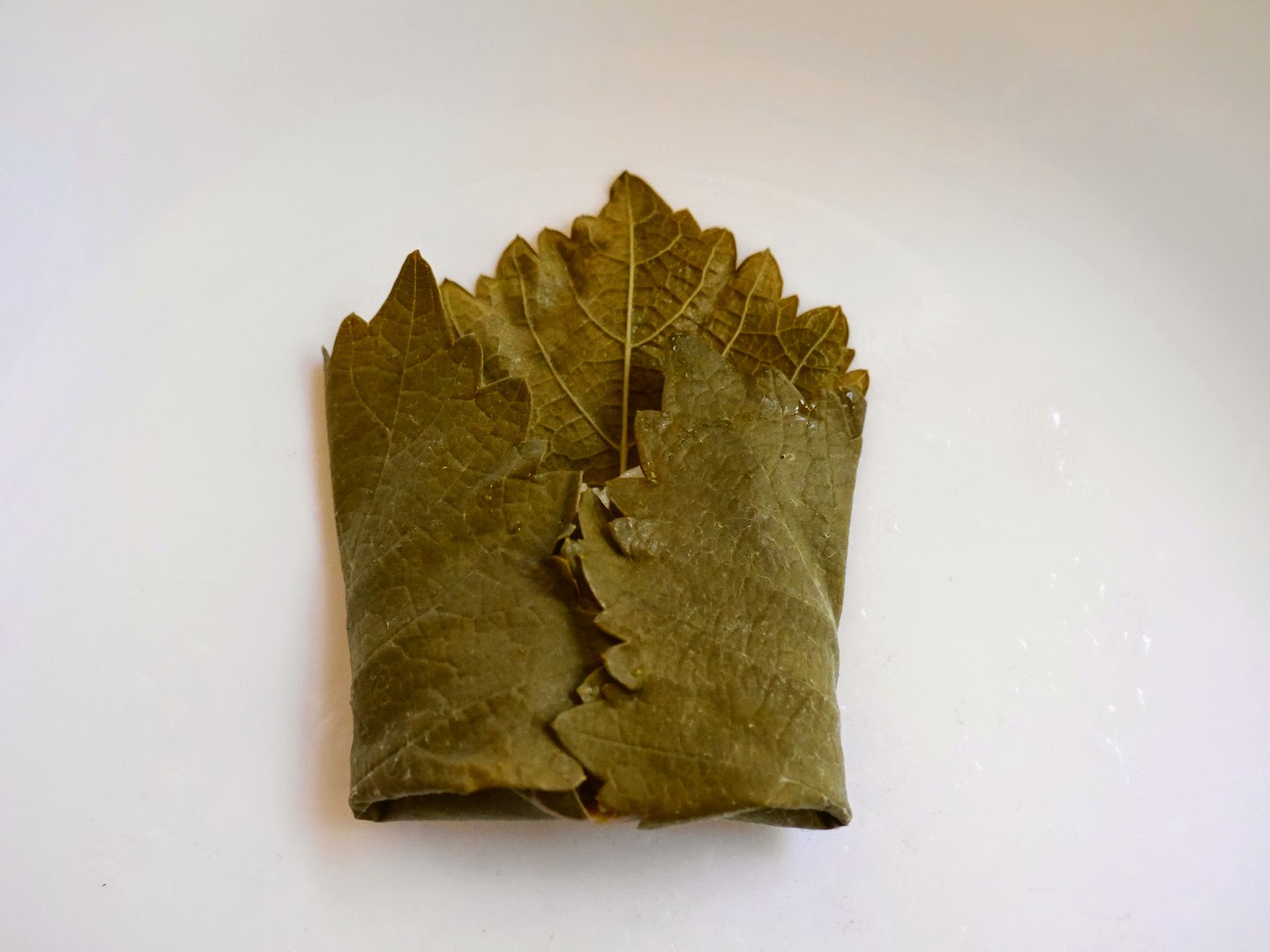
To assemble the dolmades, lay a blanched and dried grape leaf on a flat surface, shiny side down. Place 1 tablespoon of filling near the stem end of the leaf. 


Fold the stem end of the leaf over the filling.


Then fold in both sides towards the filling.


Then roll up completely.


Place dolmades seam-side down in a 9"x13" casserole dish. Repeat until you fill the pan. You may have left over filling. 

Add 1 tablespoon of olive oil and two tablespoons of lemon juice to the pyrex with the remaining cup of broth. Stir well and pour over the dolmades. 


Tightly cover with foil and bake at 350 degrees F for 30 minutes or until the grape leaves can be easily pierced with a fork.


Remove from the oven and let cool with the foil remaining on the casserole dish.

Serve at room temperature or store in the refrigerator, covered, until needed.


Per serving: 42 calories, 2 g total fat, 0 g saturated fat, 34 mg omega-3 and 505 mg omega-6 fatty acid, 0 mg cholesterol, 1 g protein, 6 g carbohydrates, 1 g dietary fiber, and 89 mg sodium (using a large Rapunzel bouillon cube and 1/2 teaspoons added salt). 


Wednesday, May 29, 2013

Vegan Panko-Crusted Tofu With Dijon Mustard

The Dijon mustard gives this panko breading intense flavors!

Follow Foods For Long Life on FACEBOOK .

Soy is a Healthy Food
I have always come squarely down on the side that says soy is a healthy food. Obviously you shouldn't eat soy if you are allergic to it, but eating moderate amounts of whole soy foods such as edamame or tofu is good for most people. It's an excellent source of vegetarian "complete" protein. Soy has been shown to relieve menopausal symptoms such as hot flashes and is linked with lower risks of breast and endometrial cancer. The FDA claims that eating 25 grams of soy protein per day may help reduce the risk of heart disease. Eating lots of fake meats with soy isolates or taking it as a supplement is not recommended. 

But despite the positive studies, eating soy remains a controversial subject. This topic comes up at every health conference and this year's 2013 Health and Nutrition conference was no exception. Dr. Weil discussed it the first day. He feels that there is a lot of misinformation about soy, most of which comes from the meat and dairy industries. The controversy arises from the fact that soy contains isoflavones that have estrogenic activity and some claim that they might accelerate some breast cancer cells or be bad for developing young boys. Studies have shown, and Dr. Weil agrees, that soy blocks access to estrogen receptors and is even safe for women with estrogen receptor positive breast cancer. And no, it does not feminize boys.

Today's recipe
I enjoy tofu once or twice a week. Here's a incredibly easy and flavorful way to prepare it.
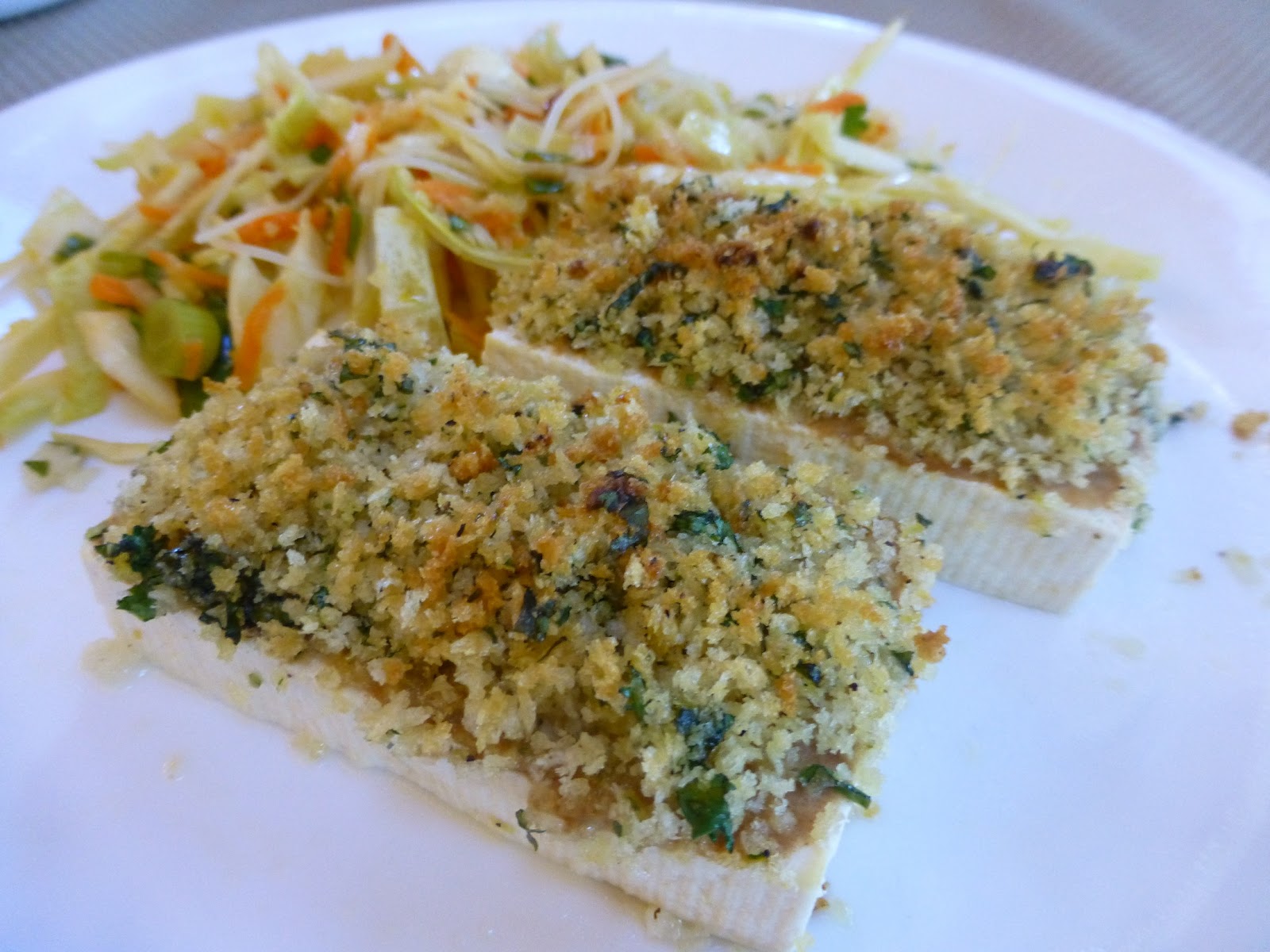
The Dijon mustard in this recipe not only serves to hold the breading onto the tofu, but it adds an intensely wonderful flavor to the dish. Other than heating the tofu and browning the breading, there is not much to cook so the entire recipe goes together very quickly.
I serve it with Thai Cabbage, Daikon and Carrot Salad.

             *                    *                      *                     *
Panko-Crusted Tofu
Vegan
Requires a shallow roasting pan
[makes 3 (2-piece) servings]

2 tablespoons extra virgin olive oil plus some to grease the pan
1 pressed garlic clove
1 packed teaspoon grated lemon zest
2/3 cup Panko bread crumbs
1/4 teaspoon salt or to taste
1/4 teaspoon black pepper
2 tablespoons chopped fresh cilantro or parsley
1 (14 to 16 ounce) block extra-firm organic tofu
1 tablespoon Dijon mustard

Preheat the oven to 375 degrees F. Grease a shallow roasting pan with olive oil.

In a small bowl, combine garlic, lemon zest, bread crumbs, salt, pepper, and cilantro (or parsley). Drizzle in 2 tablespoons of olive oil until the bread crumbs are well coated. Set aside.

Make the breading.

Cut the block of tofu into 6 slices. Lay them down in the greased roasting pan and spread each evenly with 1/2 teaspoon of Dijon mustard. 

Coat the tofu with Dijon mustard.

Sprinkle the Panko mixture over the tofu. It should stick to the mustard.

The breading should adhere nicely to the mustard.

Bake in the oven until the tofu is hot and the bread crumbs are slightly toasted and brown.

Remove from the oven and serve immediately.

Serve with Thai Cabbage, Daikon and Carrot Salad.

Per serving (2 pieces of tofu): 272 calories, 18 g fat, 2.7 g saturated fat, 421 mg omega-3 and 3,996 mg omega-6 fatty acids*, 17 g protein, 15 g carbohydrates, 2.2 g dietary fiber and 356 mg sodium.

* Nutritional information for omega-3 and omega-6 excludes any contribution from the Panko bread crumbs since that information is not available from the manufacturer.